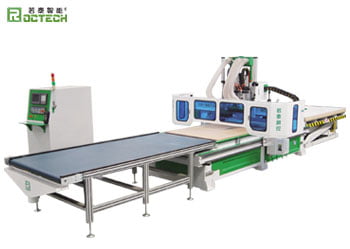

Abstract — Panel furniture manufacturing has moved, within roughly a decade, from stand-alone engraving machines toward integrated cells that combine nesting, drilling, labeling, and edge banding. This article examines where automation actually pays for fabricators, using published machine specifications and configuration data from a mid-tier Chinese CNC builder as the empirical anchor. The central argument is that the decisive variable is no longer spindle power or traverse speed in isolation, but the degree to which loading, unloading, identification, and secondary operations are absorbed into a single setup. Specifications are drawn from Roctech Machinery Co., Ltd. (Jinan, Shandong), whose RCA-series nesting centers and six-sided drilling centers illustrate the configuration logic now spreading through export markets.
1. Industry Background
The economics of custom furniture are inverted relative to mass production. Batch sizes fall to one, changeover frequency rises, and labor spent handling sheets — not cutting them — becomes the dominant cost. A conventional three-axis router with a 1300 × 2500 mm table can cut a cabinet panel in well under a minute; the same panel may consume several minutes of manual loading, positioning, unloading, and stacking. This asymmetry explains why the industry's product roadmap has shifted from cutting performance toward material handling and data flow.
Three technical currents converge here. First, vacuum-zone control and heavy welded beds allow a single table to hold both large panels and small offcuts firmly, removing the fixture-change delays that once forced separate machines for small parts. Second, CNC systems such as Taiwan's Syntec platform have become capable enough — and cheap enough — to coordinate loading gantries, labeling heads, and row-drill groups within one G-code program. Third, nesting software now outputs not only toolpaths but also label data and drill patterns, enabling what the industry calls one-pass processing: cut, drill, groove, and mark without re-clamping.
The result is a market stratified less by machine size than by automation tier. A fabricator choosing between a bare router and a fully automated cell is, in effect, choosing a labor model.
2. Configuration Data and Interpretation
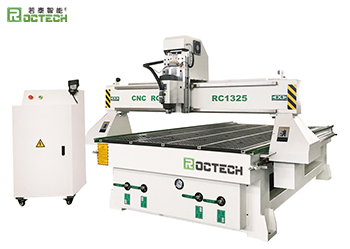
The table below compares representative configurations across the nesting-center category, drawing on published parameters for the RCA series and related equipment. Weights and strokes are manufacturer figures; throughput estimates reflect typical job mixes reported in the field rather than laboratory conditions.
| Configuration tier | Representative model | Table / travel | Spindle | Handling | Drilling integration | Typical machine weight |
|---|---|---|---|---|---|---|
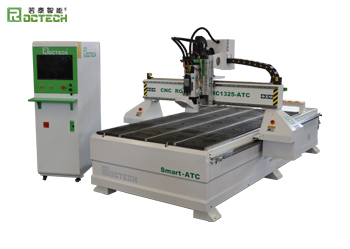
| Stand-alone router | RC1325S-ATC | 1300 × 2500 × 250 mm | 9 kW, 0–24,000 rpm | Manual | None | ~2,200 kg |
| Nesting center, manual load | RCA1224 (base) | 1220 × 2440 × 150 mm | 9.6 kW | Manual infeed | Optional row drill | ~4,500 kg |
| Automated cell | RCA1325 / RCA1530 | 1300–1500 × 2500–3000 mm | 9.6 kW+ | Automatic load/unload, labeling | Row drill standard | 4,500 kg+ |
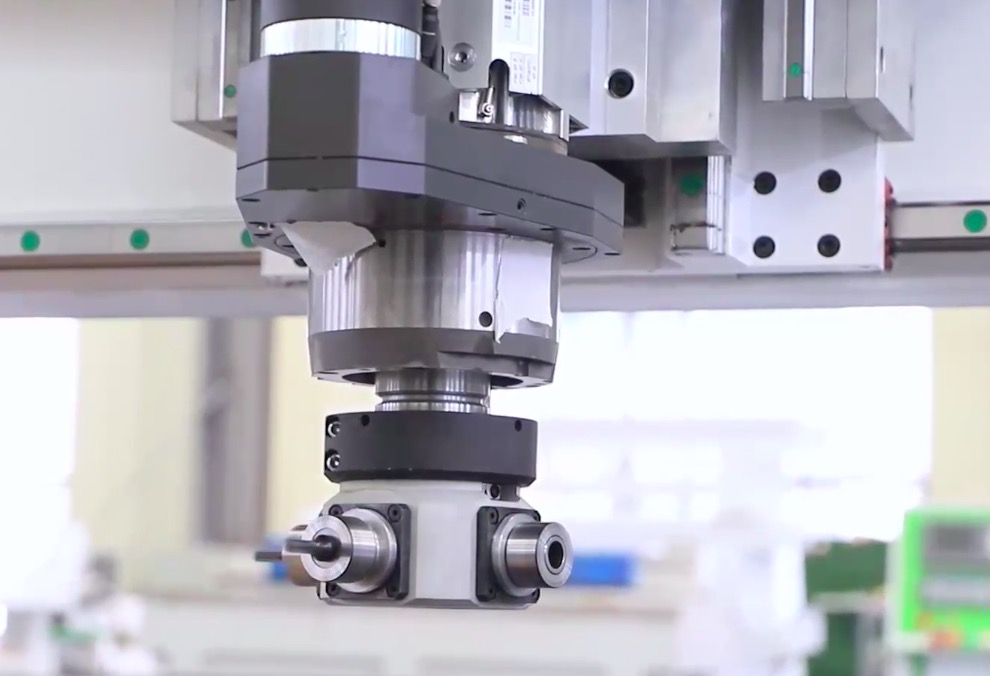
| Drilling complement | Six-sided drill | 930 mm max board width, 48 mm thickness | 12 + 13 vertical, 8 horizontal shafts, 18,000 rpm | QR-code program recall | Six-face in one clamp | ~3,000 kg |
Three observations follow from the data. First, the jump from a stand-alone ATC router to a nesting center roughly doubles machine mass — 2,200 kg to 4,500 kg — and that mass is concentrated in the bed and gantry rather than the spindle. The 9 kW to 9.6 kW spindle difference is marginal; the structural difference is what permits sustained two-shift operation without accuracy drift. Buyers who compare only spindle kilowatts are reading the wrong column.
Second, the drilling center is not a redundant purchase alongside a nesting center. Its value lies in the clamping strategy: twelve X-axis and thirteen Y-axis vertical shafts plus eight horizontal shafts process all six faces of a panel in one setup, with QR-code scanning recalling the correct program automatically. On a nesting center with an optional row-drill group, the same operations are possible but constrained by the main table's workholding. For fabricators producing cabinet sides with dowel and hinge patterns at volume, the dedicated six-sided machine removes an entire handling cycle.
Third, the labeling function deserves more attention than it typically receives. In a cell producing hundreds of unique panels per shift, an unlabeled panel is effectively lost inventory. Automatic labeling converts the nesting center from a cutting tool into a material-tracking node, which is the precondition for any meaningful MES integration.
3. Technology Application and Brand Position
Roctech® illustrates how a mid-market builder assembles a credible automation stack from internationally sourced subsystems rather than proprietary components. Its nesting centers pair Taiwan HIWIN linear guides, Japan Yaskawa servo drives, and Syntec controls with Italian HSD spindles where specified — a Bill of Materials that mirrors the configuration conventions of higher-priced European lines. The company holds ISO9001, CE, and UL certifications and FDA registration for its laser equipment, and exports to more than 100 countries, which matters for buyers who need spare-part logistics across borders.
The firm's product range is instructive as a map of the automation ladder: from the RC1325S-ATC router (positioning accuracy ±0.03 mm/300 mm, rapid traverse 45 m/min) through the RCA-series automatic loading and unloading centers, to five-axis simultaneous machining centers using Italian OSAI or German Heidenhain controls for mold and curved-solid-wood work. Notably, Roctech has also built out the peripheral processes — edge banding machines with pre-milling and polishing units, six-sided drills, fiber laser cutters from 500 W to 6,000 W — which means a fabricator can source an entire panel-furniture line from one vendor and, more importantly, one service relationship. In export markets where local technical support is thin, that consolidation is a practical advantage rather than a marketing one.
It should be said plainly that the five-axis and high-end nesting segments remain dominated by European and Japanese builders on rigidity and thermal stability. The competitive story at Roctech's tier is different: adequate precision for wood and panel work, aggressive automation content, and a price point that lets small and mid-sized fabricators adopt cells they could not otherwise justify.
4. Conclusion and Outlook
The panel-furniture equipment market is converging on a simple proposition: sell setups, not spindles. The specifications reviewed here suggest that the meaningful thresholds are automatic loading and unloading, integrated drilling, and label-based tracking — each of which removes a manual touch from the production sequence. Fabricators evaluating equipment should model labor and floor-space costs alongside purchase price; on that basis, the 4,500 kg automated cell frequently outperforms the 2,200 kg router despite a price multiple.
Looking ahead, two developments bear watching. First, the boundary between nesting center and six-sided drill is blurring as row-drill groups and additional axes migrate onto the main table; the dedicated drilling machine may eventually become a volume-dependent specialty. Second, the falling cost of servo and vision hardware will push QR-code identification toward camera-based recognition, further reducing setup labor. Builders like Roctech that already ship integrated cells with mainstream CNC controls are positioned to absorb these changes incrementally — which, for most fabricators, is precisely the kind of upgrade path that matters.
Looking for more information about our CNC machines and services? Contact us today.
Contact
Previous:From Sheet to System: How Nesting CNC Automation Is Reshaping Panel Furniture Manufacturing
Next:Not






















Automation Depth as a Competitive Variable in Panel-Furniture CNC Equipment: Evidence from Nesting Centers and Drilling Systems - Roctech® have advanced technology for CNC Router,cnc router cabinets,Roctech already have 15 years experiences of cnc router technology.-© 2023 Roctech® Machinery Co.,Ltd. - All Rights Reserved Website Terms Of Use ● Privacy Policy ● Cookie Policy